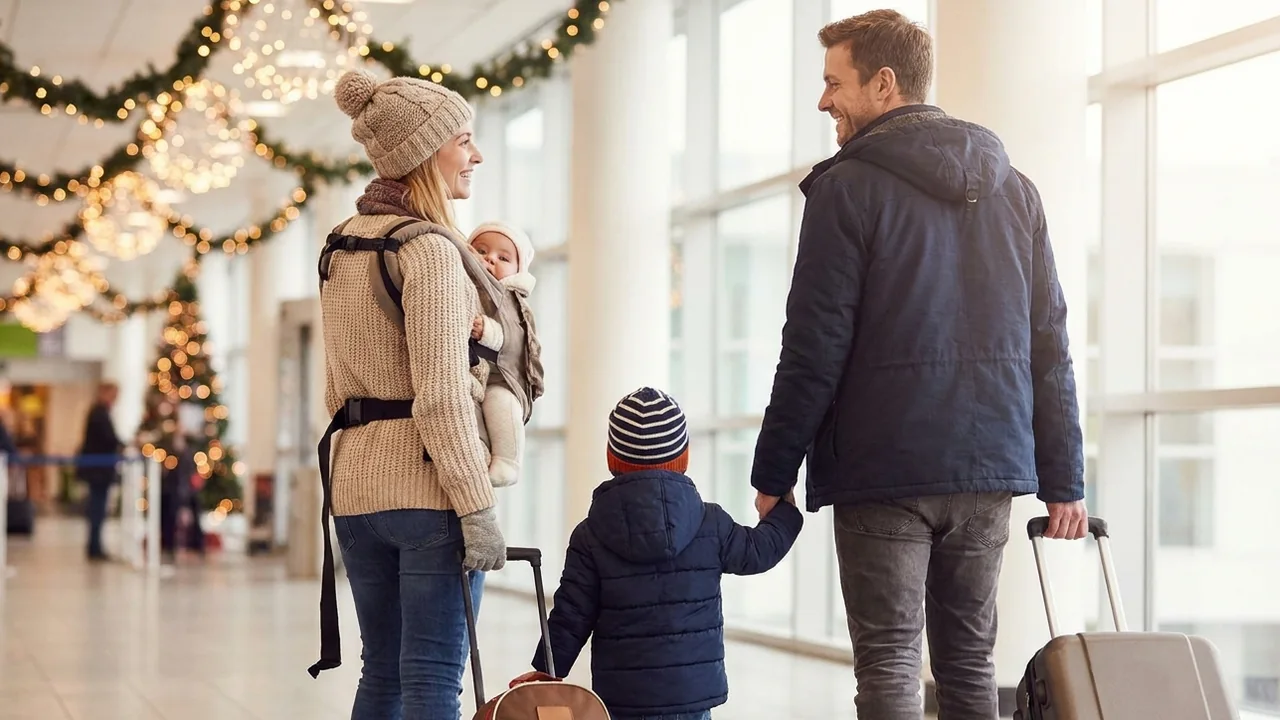
Most healthy babies can travel safely over the holidays. The difference between a smooth trip and a stressful one usually comes down to timing, germs, and a few car seat and sleep details.
With Thanksgiving and Christmas just around the corner and Utah’s flu season already off to an early start, many parents are deciding whether to fly, drive, or stay home this year. Here’s what we tell families in our exam rooms: when babies are old enough to travel, how to lower the risk of illness, how to fly or drive more safely, and when to call us.
If you only have a few minutes before you book, start here:
There’s no single age that’s right for every family. The AAP says it’s ideal to wait until your baby is 2 to 3 months old to fly, because crowded airports can expose newborns to colds, flu, and other infections. The AAP has also advised families to consider avoiding travel with babies under 6 months when possible, since they’re at higher risk of illness and too young to be vaccinated against many winter viruses. Most pediatricians don’t recommend any travel before 2 months.
Here’s a simple way to think about it:
| Baby’s age | What to know | What we suggest |
|---|---|---|
| Under 2 months | Most vulnerable to infections. Most pediatricians don’t recommend travel at this age. | Stay home if you can, let family come to you, and call us before making any plans. |
| 2 to 6 months | Fine for many healthy babies, but too young for a flu shot. | Travel only if you need to. Focus on RSV protection, handwashing, and avoiding sick contacts. |
| 6 to 12 months | Old enough for the flu vaccine. More wiggly in laps and car seats. | Get the flu vaccine, plan for breaks, and give your baby their own seat. |
Talk with us before you travel if your baby was born early, has a heart or lung condition, or has had an ear infection or ear surgery in the past two weeks.
If you have a newborn at home, hosting this year may be the easiest option. It keeps your baby’s routine intact and limits exposure to crowds.
Holiday gatherings mean hugs, shared snacks, and relatives who “just have a little cough.” Babies’ immune systems are still learning, so a few steps can lower the risk.
Protect your baby with the flu vaccine. Babies can’t get a flu shot until they’re 6 months old, so the best way to protect a younger baby is for everyone in the household to get theirs. The AAP recommends annual flu vaccination for all children 6 months and older, as well as for the family members and caregivers of babies who are too young to be vaccinated. Once your baby is old enough, schedule a flu shot before you travel.
Ask about RSV protection. Before today’s prevention options existed, an estimated 2% to 3% of infants younger than 3 months were hospitalized with RSV each year, most of them otherwise healthy. For the 2026–27 season, babies can be protected in one of three ways:
Most babies don’t need an antibody if their mother was vaccinated at least two weeks before delivery. Not sure whether your baby is protected? Call us before you go.
Talk about sick relatives before you go. Every family has a different comfort level, so talk with relatives ahead of time about illness and vaccines. The AAP suggests testing for flu, RSV, and strep when someone is sick, and notes that masks can help in enclosed spaces like planes and airports. Ask anyone with symptoms to wait to hold the baby, and have everyone wash their hands first.
If your baby is sick before you leave, call us first. Our Is Your Child Sick? page can help you decide what to do next.
Buy your baby a seat if you can. The FAA doesn’t require a ticket for children under 2, so holding your baby on your lap is allowed. But the FAA strongly discourages it, and the AAP says turbulence is the leading cause of children’s injuries on planes. Your arms can’t reliably hold a baby through a bumpy patch. The safest option is an approved car seat in their own ticketed seat, and buying a ticket is the only way to guarantee you can use one.
Check the label on your car seat. It should say it is certified for use in motor vehicles and aircraft. Most rear-facing, convertible, and forward-facing seats qualify, but booster seats and travel vests don’t. Install the seat in a window seat so it doesn’t block anyone’s path in an emergency, and never in an exit row. The FAA-approved CARES harness is only for children 22 to 44 pounds who can sit upright on their own, so it’s not an option for babies.
Know the rules for takeoff and landing. During takeoff, landing, and turbulence, your baby needs to be buckled into a car seat or held on your lap. Baby carriers can’t be used during takeoff or landing.
Pick your seats wisely. Window seats and bulkhead rows give you more room. Skip the aisle, where hot drinks and carts pass by, and avoid exit rows. The U.S. Department of Transportation’s airline family seating dashboard shows which airlines guarantee seats together at no extra charge for an adult and a child under 13.
Help your baby’s ears. Pressure changes during takeoff and landing can be uncomfortable. A bottle or pacifier during both can ease it. If your baby has had an ear infection or ear surgery in the past two weeks, ask us before you fly.
Plan for airport security. Formula, breast milk, toddler drinks, and baby food over 3.4 ounces can go in your carry-on and don’t need to fit in a quart-size bag. Tell the TSA officer at the start of screening, and expect them to be screened separately. Your baby doesn’t need ID at TSA when traveling with an adult, but your airline may ask for proof of age if you’re flying with a lap infant.
Use the family amenities at Provo Airport and Salt Lake City International Airport. Provo Airport (PVU) has a private Mother’s Room in the Family Lounge across from Gate 2, with comfortable seating, an outlet, a changing table, and a sink. Family restrooms are located throughout the terminal. Salt Lake City International Airport has 20 Mother’s Rooms inside women’s restrooms, plus changing tables in most men’s and women’s restrooms. Breastfeeding is welcome anywhere in the SLC airport.
Keep sleep safe in the air. If your baby falls asleep on your lap, stay awake and alert, and keep their face uncovered. Some airlines offer bassinets, usually for babies under 6 months or 20 pounds. If you use one, make sure the surface is firm and flat with no blankets or pillows. Ask your airline about bassinets before you book.
Driving can mean fewer crowds and fewer germs, and the AAP points out that a car lets you stop as often as you need and follow your own schedule. Utah winters add a few extra steps.
Check conditions before you leave. UDOT can require traction devices during severe winter weather on roads including I-80 in Parleys Canyon and US-40 in Summit and Wasatch Counties. Requirements are posted on road signs, message boards, and the UDOT Traffic app. UDOT recommends delaying travel until conditions improve if you’re unsure about driving in winter weather, and with a baby in the back, that’s good advice.
Take regular breaks. The AAP suggests stopping every 2 to 3 hours on a day trip to feed and change your baby and stretch. Never breastfeed in a moving car. If you can, have a second adult ride in the back seat with the baby.
Dress your baby in thin layers. Bulky coats and snowsuits can compress in a crash and leave the harness too loose. Buckle your baby in thin layers first, then wrap a coat or blanket over the harness. Skip any inserts or padding that didn’t come with your car seat, per the AAP.
Keep your baby rear-facing. The AAP recommends that infants and toddlers ride rear-facing as long as possible, until they reach the highest weight or height limit of their seat. Many convertible seats allow this for 2 years or more. Rear-facing seats always go in the back seat if your car has an active front passenger airbag.
Pack for delays. Winter storms can mean long waits on the road. Keep extra diapers, wipes, a change of clothes, formula or breast milk in a cooler, a thermometer, blankets, a phone charger, and a full tank of gas in the car.
Traveling a long way? Consider splitting the drive over two days so you’re not rushing to make up time.
Neither is right for every family. The AAP notes that traveling by car can help you avoid crowds and the germs that come with them, but flying may be the only practical choice for long distances. Here’s how they compare:
| Flying | Driving | |
|---|---|---|
| Germ exposure | More exposure in crowded airports and cabins | Fewer people around, so usually fewer germs |
| Car seat | An approved car seat in your baby’s own ticketed seat is safest | A correctly installed rear-facing car seat, with thin layers under the harness |
| Breaks | You can’t unbuckle during takeoff, landing, or turbulence | Stop every 2 to 3 hours to feed, change, and stretch |
| Feeding | Breast milk and formula over 3.4 ounces are allowed; offer a bottle or pacifier during takeoff and landing for ear comfort | Pack a cooler; never breastfeed in a moving car |
| Winter weather | Delays and cancellations | Canyon and mountain pass conditions; check the UDOT Traffic app |
| Best for | Long distances, if you can buy a seat and bring a car seat | Shorter trips and flexible schedules |
Whichever you choose, the biggest safety wins are the same: an approved, correctly installed car seat, vaccinated family members, and a plan for breaks.
Pack for delays, and keep these within reach in your carry-on or the back seat:
Even with careful planning, babies can get sick on the road. Call us if your baby:
Important: A baby younger than 3 months with a temperature of 100.4°F (38°C) or higher needs immediate medical evaluation, even while you’re traveling.
Seek emergency care if your baby has difficulty breathing, bluish lips or face, seizures, severe dehydration, or is difficult to wake or not responding normally.
If you’re away from home, go to the nearest urgent care or emergency room, then call us when you’re back so we can follow up. For help outside office hours, see our After Hours page.
The AAP says it’s generally safe to fly once a newborn is at least 7 days old, but it’s ideal to wait until your baby is 2 to 3 months old. Most pediatricians don’t recommend any travel before 2 months because newborns are especially vulnerable to infections. Talk with us before booking.
The FAA allows children under 2 to fly as lap infants, but it strongly discourages it. Turbulence can make it hard to hold on to your baby. The safest option is an approved car seat in your baby’s own ticketed seat. If you do fly with a lap infant, ask the airline whether there’s an empty seat next to you where you can install a car seat.
Generally, no. Car seats, booster seats, and strollers usually aren’t counted as luggage, and you can often check them at the gate at no extra cost. Policies vary by airline, so confirm before you book.
A bottle or pacifier during takeoff and landing can ease pressure. If your baby has a cold or an ear infection, ask us about infant pain relievers and the right dose. If your baby had an ear infection or ear surgery in the two weeks before your trip, ask us before you fly.
Yes. Formula, breast milk, toddler drinks, and baby food over 3.4 ounces are allowed in your carry-on and don’t need to fit in a quart-size bag. Tell the TSA officer at the start of screening, and let them know if you’d rather the items not be X-rayed or opened.
The AAP suggests a break every 2 to 3 hours on a day trip so you can feed, change, and stretch. Never breastfeed in a moving car.
No. Bulky coats and snowsuits can compress in a crash and leave the harness too loose. Dress your baby in thin layers, buckle them snugly, and then place a coat or blanket over the harness.
No. Benadryl (diphenhydramine) can have serious side effects, and some children become more alert instead of sleepy. Call us if you have questions about safe options for your baby.
Ask us whether your baby is up to date on their routine vaccines. The AAP recommends flu vaccine for all children 6 months and older, and babies younger than 6 months can’t get a flu shot yet. Ask us whether your baby is also protected against RSV. If you’re traveling outside the U.S., check the CDC’s destination list and talk with us well before your trip.
Call us before you go. We can check for an ear infection or other concerns and help you decide whether it’s OK to travel.
Traveling with a baby doesn’t have to be perfect to be safe. The right timing, a plan to protect your baby from illness, and an approved car seat go a long way.
At Utah Valley Pediatrics, our pediatricians can check whether your baby is up to date on vaccines, talk through your travel plans, and answer your questions about medicine, feeding, and sleep before you go. You can also book a flu shot appointment for your baby once they’re 6 months old.
Planning holiday travel with your baby? Contact Utah Valley Pediatrics or schedule an appointment.


 Medicines & Dosages
 Pay Your Bill
 Surveys & Questionnaires
 Pediatric Newsletter
 Patient Portal
 Locations